ISAAC NEWTON
 |
|---|
MOTION
Isaac Newton's 3 Laws of Motion are possibly the most significant contributions to the science of physics. During his years studying, he developed the 3 laws that are critical in understanding basic forces and motion that describe why objects move or reamin at rest, they are explained below:
FIRST LAW
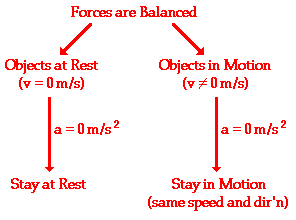
"Every object in a state of uniform motion or stationary tends to remain in that state unless an external,
unbalanced force acts upon it."
This law is also known as the Law of Inertia, as objects have generally try resist forces and remain in their state of motion or rest. Inertia describes the tendency an object possesses to resist changes in the state of motion. Galileo previosly developed the idea of friction, stating that objects would come to rest because of this force, and Newton built his studies upon Galileo's views declaring that objects would move into a stationary state as a result of any unbalanced force.
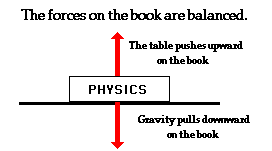
An object are always acted upon by two forces, that can be balanced or unbalanced. Balanced forces are when the forces being exerted on an object, by another, are equal to that of the forces it is exerting itself, eg; a book resting on a table is under the force of gravity, which is equal to the force of the table pushing upwards, thus leading onto the thrid law (see below).
SECOND LAW
"The accleration of an object produced by a force is directly related to the magnitude (or size) and direction of the force and inversely related to the mass of the object."
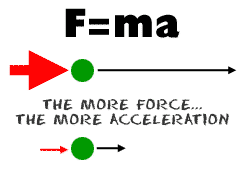
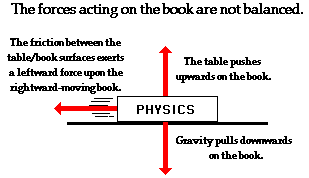
eg: the greater the mass of an object being accelerated, the greater the amount of force needed to accelerate or move it. This law focuses on forced that are not balanced, where the objects accelerates or decelerates, and states that acceleration depends on the net force and inversely, the mass of the object.
Particularly, as the force increases, the acceleration is also increased and as the acceleration is decreases, mass increases. This can be summarised with the formula a = Fnet / m, or rearranged into the simple F = m x a.
A unit of force, which is measured in Newtons, is equivalent to a unit of mass multiplied by a unit of acceleration, therefore: 1 Newton = 1kg x m/s/s.

THIRD LAW
"For every action there is an equal and opposite reaction."
Every interaction between objects is affected by forces, either balanced or not, and these action and reaction forces always work in pairs. This means that the size or magnitude of the forces are equal, but the direction in which they are acting are opposite, so we can call them inversely related.
Examples of action - reaction forces include, when birds fly: {their wings push the air downwards, whilst the air pushes the bird upward} and when driving a car: {the wheels that spin, grip the road and push it backwards, as the road pushes the wheels forwards. This is due to the force of friction}.