ISAAC NEWTON
 |
|---|
GRAVITY

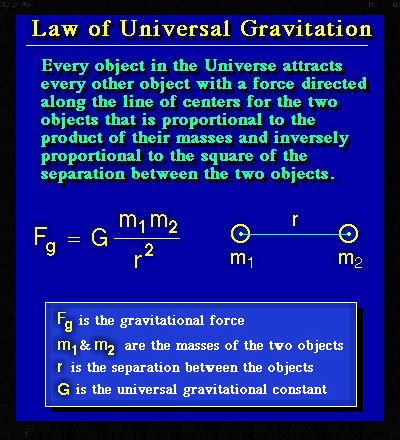
Isaac Newton is most famously known for his 'Law of Universal Gravitation' that states that every mass in the universe attracts every other mass and that the gravitational force exerted is inversely proportional to the sqaure of the distance between them. Or put simply, any 2 objects in the Universe exert a gravitational attraction on each other, and the gravitational force is directly proportional to the product of both masses.
Newton combined his research with the "Theory of Falling Bodies" from world renowned astronomer, Galileo Galieli and Johannes Kepler's "Law of Planetary Motion" and published his work in the famous Principia in 1687. An excerpt from the publication, written in that same year, "I deduced that the forces which keep the planets in their orbs must be reciprocally as the squares of their distances from the centres about which they revolve; and thereby compared the force requisite to keep the Moon in her orb with the force of gravity at the surface of the Earth; and found them answer pretty nearly."
He also proposed that spherical objects attract other objects as if their mass is concentrated in their centre and that any hollow sphere does not exert a gravitational force on any object placed inside. The force of gravity is a vector quanitity and therefore gravitational force of one object is equal and opposite to the gravitational force of another object, this conincides with Newton's 3rd Law of Motion.

One of Newton's experiements, was one of thought, where he hypothosized that the force of gravity was universal, meaning that that is why planets are in motion. He published in his book, "A Treatise of the System of the World" his experiment as follows; he visualised a cannon at the top of a high mountain, and deducted from previous study that if their was no air resistance or gravitational forces, the cannon ball when fired, would travel in a straight line away from earth. However, if the force of gravity acted upon the cannonball it would fall back to earth if its velocity was small, or if it reaches what is called, 'orbital speed' it would continue along orbiting the earth on a circular path. On the other hand, if the cannonball was fired at a high speed, it would either leaved the orbit of the earth completely, or continue an elliptical orbit .